Table of Contents
ToggleA print can look flawless on your monitor, but a single tiny scaling blunder can easily turn a precise layout into an incredibly expensive nightmare. This is exactly why CAD conversion scale accuracy stands out as a critical element in any blueprint migration job. Whether you are changing old scans, PDFs, or legacy files into editable vector sheets, keeping measurements spot-on is vital for field engineers, designers, suppliers, and site builders.
A ton of jobs get tripped up by common roadblocks like PDF to CAD conversion scale issues, lost dimension lines, warped original scans, and mismatched unit configurations. These hidden hiccups usually slip past unnoticed until shop fabrication or actual site building kicks off. By then, even a tiny mismatch can stall timelines, force heavy rework, and blow up budgets.
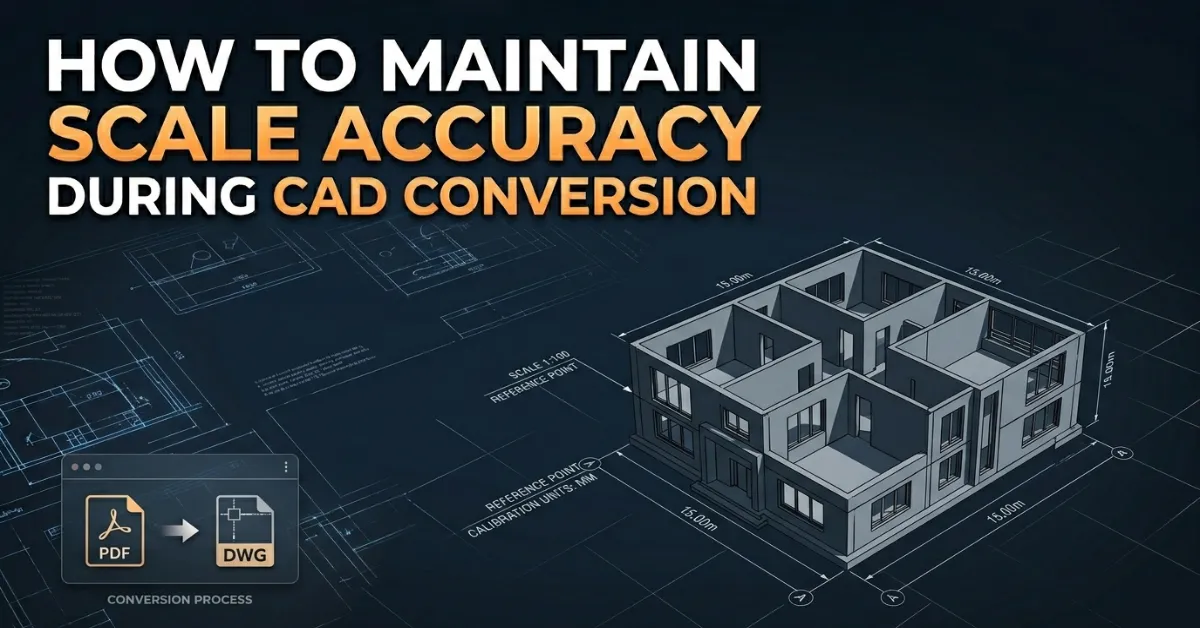
Protecting CAD conversion scale accuracy demands a highly systematic pipeline, thorough cross-checking habits, and strict quality control practices. This breakdown dives into the most reliable methods to lock in scale integrity as you change file formats, guaranteeing trustworthy, field-ready outputs for modern project workflows.
In today’s digital environment, technical drawing accuracy is not simply a preference—it is a necessity.
The growing demand for precise engineering documentation has made scale verification a critical step in every conversion workflow. As highlighted in standard drafting guides from Autodesk, keeping dimensions perfectly true to life directly lowers project liabilities and keeps communication clear between engineering crews and project owners.
Why CAD Conversion Scale Accuracy Matters
Every layout holds specific data meant to steer site builds, factory runs, equipment setups, and long-term upkeep. When these numbers are off, the whole job can suffer. True CAD conversion scale accuracy ensures that physical distances stay perfectly uniform from the raw source document all the way to the finished CAD file.
A newly drafted vector file typically becomes the core template for later modifications, system additions, and overall master planning. If your proportions drift during format changes, every single revision that follows becomes full of errors. This is incredibly critical when handling structural frames, factory equipment footprints, architectural floor plans, and civil infrastructure grids.
Drawing scale conversion accuracy supports effective communication among project teams. Contractors, engineers, fabricators, and consultants depend on reliable dimensions to complete their tasks correctly. A single scaling issue may create confusion across multiple departments.
In addition, accurate scaling contributes to regulatory compliance and project documentation requirements. Multiple commercial fields demand absolute precision records that perfectly mirror the original project specs. Locking down CAD conversion scale accuracy ensures that your digitized files stay highly reliable and ready for professional submission.
Projects that prioritize scale accuracy typically experience fewer revisions, reduced rework, and smoother workflows throughout the design and construction lifecycle.
Common Causes of PDF to CAD Scale Issues
Many scale-related problems occur long before the conversion process begins. Understanding these causes helps prevent errors and improves final output quality.
PDF to CAD scale issues frequently originate from low-quality scans. Older paper drawings may be stretched, folded, faded, or distorted over time. When these drawings are scanned, dimensional inconsistencies can appear across the document.
Incorrect unit settings are another common challenge. Some files are created in millimeters, while others use inches, feet, or meters. If conversion software interprets units incorrectly, the resulting CAD file may be significantly larger or smaller than intended.
Resolution problems can also affect scale accuracy. Low-resolution scans often make it difficult to identify exact reference points. As a result, conversion teams may struggle to establish accurate dimensions.
Another factor involves improper import settings during conversion. Automatic scaling features can sometimes alter dimensions without immediate detection. Small adjustments introduced by software algorithms may accumulate across large drawings.
Missing reference dimensions further complicate the process. Without clear measurement data, establishing correct scale becomes challenging. This increases the likelihood of estimation errors during conversion.
Understanding these potential issues is the first step toward achieving reliable CAD conversion scale accuracy and preventing costly mistakes later in the project.
Understanding Drawing Scale Conversion Accuracy
Drawing scale conversion accuracy refers to the ability to preserve the original relationship between dimensions and real-world measurements during conversion. This principle forms the backbone of reliable CAD documentation.
A properly scaled drawing maintains proportional relationships throughout the entire design. Walls remain correctly spaced, mechanical components fit together properly, and structural elements align as intended.
The conversion process should replicate every measurement without introducing distortion. This requires careful attention to scaling factors, reference dimensions, and coordinate systems.
The following table highlights common scaling risks and their potential impact:
Conversion Challenge | Potential Impact |
Incorrect units | Oversized or undersized drawings |
Distorted scans | Misaligned geometry |
Missing dimensions | Scale estimation errors |
Poor image quality | Inaccurate tracing |
Auto-scaling features | Dimension inconsistencies |
Manual adjustment mistakes | Reduced technical drawing accuracy |
Maintaining drawing scale conversion accuracy requires verification at multiple stages rather than relying solely on automated software processes.
When scaling integrity is preserved, converted drawings remain dependable for future design revisions, engineering analysis, and construction planning.
Best Practices for Maintaining CAD Conversion Scale Accuracy
Successful conversion projects follow a disciplined workflow that prioritizes accuracy from start to finish. Several proven practices help maintain CAD conversion scale accuracy consistently.
The first step involves identifying reliable reference dimensions before conversion begins. Known measurements provide benchmarks that support scale verification throughout the process.
Next, conversion teams should verify units carefully. Confirming whether the source drawing uses millimeters, inches, meters, or feet helps prevent major scaling discrepancies.
High-resolution source files also improve accuracy. Clear scans make it easier to identify critical geometry and dimensional references.
Another important practice involves cross-checking multiple dimensions after conversion. Relying on a single measurement may overlook localized distortions. Multiple verification points provide stronger confidence in overall scale integrity.
Verification reviews need to happen at multiple stages of the timeline rather than saving them all for the final step. Checking your work continuously lets you spot minor drift before it ruins large sections of the digital blueprint.
Professional CAD specialists often compare converted drawings against original documentation to confirm dimensional consistency. This additional verification layer significantly improves drawing scale conversion accuracy.
Projects that incorporate these practices consistently achieve better outcomes and maintain dependable CAD conversion scale accuracy across complex documentation requirements.
Also read: Common Errors in PDF to CAD and How to Avoid Them
The Role of Scale Calibration in CAD Conversion
Scale calibration acts as the bridge between the source document and the final CAD drawing. It ensures that measurements correspond accurately to real-world dimensions.
Scale calibration begins by selecting reliable reference points within the original drawing. These reference points serve as anchors during the conversion process.
Once calibration is established, dimensions can be verified throughout the drawing. Any discrepancies become easier to identify and correct before final delivery.
Accurate scale calibration is particularly important when working with scanned documents. Physical drawings often experience stretching or distortion over time. Calibration helps compensate for these variations and restores dimensional reliability.
Another benefit involves consistency across multiple sheets.Massive builds frequently involve dozens or hundreds of independent design sheets. Running a proper scale calibration ensures that every single page adheres to the exact same dimension rules.
Without this manual calibration step, even the most expensive vector tracking software can pump out distorted results. For this reason, calibration remains a critical component of CAD conversion scale accuracy and technical drawing accuracy.
Organizations that emphasize calibration often experience fewer project delays and improved confidence in their converted documentation.
CAD Drawing Scale Management for Large Projects
Large-scale projects introduce unique challenges that require careful planning and control. Effective CAD drawing scale management becomes essential when dealing with extensive documentation sets.
Commercial expansions, processing plants, transit lines, and assembly floors rely on hundreds of linked schematics. Even a fractional scaling mismatch can spark massive structural coordination headaches on site.
CAD drawing scale management focuses on maintaining uniform standards across all project files. Consistent units, templates, layer structures, and dimension settings help reduce variability.
Documentation procedures also play a key role. Clearly recording scale assumptions and verification methods helps maintain consistency between team members and project phases.
Regular audits support ongoing accuracy. Reviewing selected drawings at scheduled intervals allows teams to identify emerging issues before they spread across the project.
Another important strategy involves standardizing conversion workflows. Consistent processes reduce the likelihood of human error and improve predictability.
Strong CAD drawing scale management ultimately protects project quality while supporting efficient collaboration among stakeholders working across multiple disciplines.
CAD Quality Control Techniques for Scale Verification
Maintaining CAD conversion scale accuracy depends heavily on robust quality control procedures. Even experienced professionals rely on systematic reviews to ensure reliable outcomes.
CAD quality control begins with dimensional verification. Critical measurements should be checked against original references immediately after conversion.
Visual inspection provides another layer of validation. Reviewing geometry, alignments, and layout relationships often reveals issues that numerical checks may miss.
A structured quality control process commonly includes:
- Dimension verification against source drawings
- Unit consistency checks
- Scale calibration review
- Geometry alignment validation
- Final documentation approval
Up-to-date CAD quality control protocols rely on a mix of human drafting expertise and automated verification scripts. Taking this balanced path makes it much easier to catch blatant errors along with tiny, hidden measurement shifts.
Organizations that invest in comprehensive CAD quality control typically achieve higher client satisfaction and stronger project reliability. Accurate drawings reduce uncertainty and support confident decision-making throughout project execution.
Technical Drawing Accuracy and Long-Term Project Success
The true impact of technical drawing accuracy extends way past your immediate project handovers. Having highly reliable documentation smooths out long-term building maintenance, property remodels, machine retrofits, and future land expansions.
Converted CAD files often remain in use for years after the original project concludes. Future teams depend on these records to understand existing conditions and implement modifications safely.
When technical drawing accuracy is compromised, long-term challenges emerge. Equipment may not fit properly, construction updates may encounter conflicts, and maintenance activities may require additional site verification.
Securing consistent CAD conversion scale accuracy shields your business from these liabilities by locking in exact geometric relationships right from the start. Precise blueprints provide a sturdy blueprint foundation for every phase of the build that follows.
Plus, firms that stick to zero-tolerance precision standards typically build a much stronger name in the field. Clients naturally prefer bulletproof documentation because it eliminates guesswork and guarantees better field execution.
Technical drawing accuracy should therefore be viewed not merely as a conversion requirement but as a long-term investment in project success and operational efficiency.
Conclusion
Protecting CAD conversion scale accuracy calls for smart prep work, systematic cross-checking, and non-negotiable review steps. From untangling frustrating PDF to CAD scale issues to deploying proper scale calibration routines, every single detail matters for hitting an elite benchmark.
Getting your scales right protects overall technical drawing accuracy, keeps your timeline efficient, and cuts out expensive field mistakes. Backing this up with rigid CAD drawing scale management and thorough CAD quality control steps ensures high-quality deliverables across jobs of any scope.
Companies that make drawing scale conversion accuracy a top priority operate with way more confidence in their data rooms, driving down risk factors across all design, structural engineering, and site construction workflows.
Need to track down dependable, high-precision file vectorization? Reach out to our team today to look over your technical scope and get custom drafting support tailored around your record books. Request a project estimate today to guarantee that every single sheet preserves perfect CAD conversion scale accuracy.
Also read: PDF to CAD Conversion for Engineers: A Complete Guide
Frequently Asked Questions
Why is CAD conversion scale accuracy important?
At its core, CAD conversion scale accuracy guarantees that digitized plans hold onto their true physical dimensions and geometric ratios. Spot-on scaling stops layout errors, field construction conflicts, and frustrating redraw requests, keeping your structural and architectural operations running smoothly.
What causes PDF to CAD scale issues?
Standard PDF to CAD scale issues usually stem from warped original prints, mismatched metric or imperial settings, blurry image sources, omitted dimension lines, or letting software autoscale files without checking. Taking time to manually verify and calibrate fixes these bugs instantly, maximizing the precision of your final files.
How can drawing scale conversion accuracy be verified?
Drawing scale conversion accuracy can be verified by comparing converted dimensions with known reference measurements. Multiple checkpoints, unit validation, and detailed quality reviews help confirm that scale integrity remains intact throughout the conversion process.
What is scale calibration in CAD conversion?
Scale calibration is the process of matching drawing dimensions to real-world measurements using reference points. Proper scale calibration helps maintain dimensional consistency and improves CAD conversion scale accuracy across all project documentation.
Why is CAD quality control necessary after conversion?
CAD quality control helps identify dimensional inconsistencies, geometry errors, and scaling problems before final delivery. A structured review process improves technical drawing accuracy and ensures reliable CAD files for professional use.
How does CAD drawing scale management improve projects?
CAD drawing scale management promotes consistency across multiple drawings by standardizing units, templates, and verification procedures. Effective management reduces errors and supports smooth collaboration among project stakeholders.
Can technical drawing accuracy affect future project work?
Yes. Technical drawing accuracy directly impacts future maintenance, renovations, expansions, and design updates. Accurate CAD documentation provides reliable reference information that supports long-term project success and operational efficiency.